© Copyright 2020 Vanni VERONESI. All rights reserved.
Privacy Notice (ITALIANO) / Privacy Policy (ENGLISH)Cookie Notice (ITALIANO) / Cookies information (ENGLISH)
MÉMOIRE DE FIN D'ÉTUDES EN MÉDECINE ET CHIRURGIE UNIVERSITÉ DE MILAN ANNÉE UNIVERSITAIRE 2015-2016
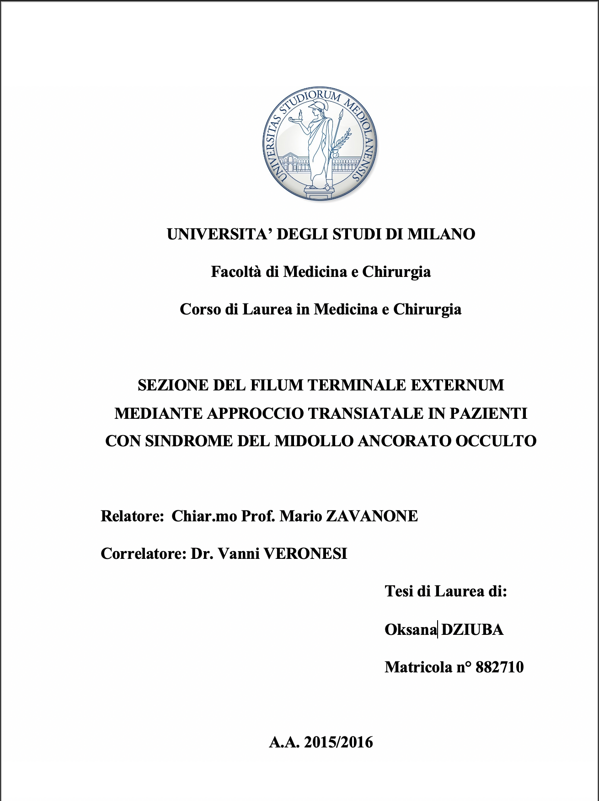

DE 2014 À 2016, LES ÉTUDES DE CAS COMPRÈNNENT 48 PATIENTS CHEUX-LUIX UN PROTOCOLE A ÉTÉ RÉALISÉ AVEC UNE IRM LOMBAIRE EN POSITION VOCALE ET UNE CHIRURGIE AVEC UNE INCISION CUTANÉE MINIMALE ET UNE TECHNIQUE DE MICROCHIRURGIE POUR LA SECTION DU FILUM TERMINALE EXTRADURAL (EXTERNUM) SOUS ANESTHÉSIE LOCALE.
Les données issues de notre protocole diagnostique et thérapeutique innovant, utilisant l'IRM lombaire en décubitus ventral et l'intervention chirurgicale par voie transhiatale pour la section du filum terminale externum par une technique microchirurgicale avec incision cutanée minimale (MIMS) sous anesthésie locale, ont fait l'objet d'une thèse de médecine et de chirurgie à l'Université de Milan.
Les patients opérés selon cette technique mini-invasive entre 2010 et juillet 2014 ont été exclus de l'étude, car la méthode diagnostique par IRM lombaire en décubitus ventral n'avait pas encore été publiée et n'avait donc pas été mise en œuvre par notre équipe.
Seuls les 48 patients opérés de la section du filum terminale externum entre le 29 juillet 2014 et le 29 juin 2016 ont été inclus dans la thèse.
L'intervention chirurgicale a été réalisée sous anesthésie locale, par une technique microchirurgicale mini-invasive, au sein du service de chirurgie du système nerveux périphérique (SSD), dont les blocs opératoires se situent à l'hôpital « Umberto I » de Lugo (Ra) et à l'hôpital « Degli Infermi » de Faenza (Ra), relevant de l'AUSL de Romagne.
L'âge des patients variait de 18 à 70 ans. On observait une nette prédominance féminine (H/F : 15/33).
Les patients ont été répartis en trois groupes :
- un groupe présentant un syndrome de la moelle attachée occulte associé à une malformation de Chiari de type I ;
- un groupe présentant une descente des amygdales cérébelleuses de 1 à 4 mm, insuffisante pour confirmer le diagnostic de malformation de Chiari de type I ;
- un groupe présentant un syndrome de la moelle attachée occulte non associé à d'autres pathologies du système nerveux.
Nous avons évalué différents symptômes et indices pré- et postopératoires, ainsi que des données issues d'IRM lombaires réalisées en décubitus ventral.
Aucune complication n'a été observée. Les patients pouvaient marcher librement quelques heures seulement après l'opération et sont sortis de l'hôpital le lendemain.
Afin de présenter les données globales, sans entrer dans le détail des quelque soixante pages de la thèse, nous rapportons l'évaluation du bien-être général perçu par le patient après l'opération, en tenant compte de l'impact sur ses activités quotidiennes et, par conséquent, sur sa qualité de vie globale. Lors de la deuxième consultation de suivi, à six mois, une amélioration a été observée chez 87 % des patients.