The reasons why I consider this scientific article published in 2009 a milestone on this subject are many: the authority of the Authors, the large case series of over 3000 patients, the fact that they also evaluated the mild descent of the cerebellar tonsils (Low-Lying Cerebellar Tonsils) and not only the descent of the cerebellar tonsils sufficient to configure Chiari type I malformation (CM1), and the correlation of the various descents of the cerebellar tonsils with tethered cord syndrome and occult tethered cord syndrome.
I would like to point out that the surgical treatment of tethered cord syndrome and occult tethered cord syndrome was performed under GENERAL ANESTHESIA with section of the INTRADURAL FILUM TERMINALE.
My minimally invasive surgical procedure under LOCAL ANESTHESIA for the EXTRADURAL section of the FILUM TERMINALE, which I will discuss further here and on other pages of the website, was published later in 2018, although I have been performing it since 2010.
© Copyright 2020 Vanni VERONESI. All rights reserved.
Privacy Notice (ITALIANO) / Privacy Policy (ENGLISH)Cookie Notice (ITALIANO) / Cookies information (ENGLISH)
PERIPHERAL NERVE INJURIES
AND VIDEOS OF REPARATIVE SURGERY
LESIONS
OF THE MOST COMMON PERIPHERAL NERVES
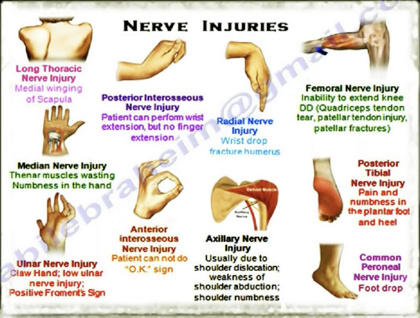
On the side, for scientific and informational purposes, a frame from a video by Prof. Ebraheim from the University of Toledo is shown, in which the most frequent injuries of peripheral nerves, the resulting muscle strength deficits, sensory alterations, and clinical signs are summarized in English.
The nerves that most commonly may suffer traumatic injuries and the resulting pathological alterations are listed, in Italian, in the box below.
- Long thoracic nerve injury - winged scapula.
- Posterior interosseous nerve injury - the patient can extend the wrist, but no finger extension.
- Radial nerve injury, often related to humerus fracture - wrist drop.
- Femoral nerve injury - inability to extend the leg (differential diagnosis: quadriceps tendon tear, patellar tendon injury, patella fracture).
- Median nerve injury – weakness of the thenar muscles of the hand and numbness of the hand.
- Anterior interosseous nerve injury - the patient cannot make the O.K. sign.
- Ulnar nerve injury - claw hand, distal ulnar nerve injury, positive Froment's sign.
- Axillary nerve injury, usually due to shoulder dislocation - weakness of shoulder movement, numbness of the skin of the lateral shoulder.
- Posterior tibial nerve injury - pain and numbness of the plantar foot and heel.
- Common peroneal nerve injury - foot drop.

READ BEFORE PROCEEDING
SENSITIVITY NOTICE FOR VISITORS
The scenes shown in the surgical videos below may disturb the sensitivity of visitors
THOSE WHO DECIDE TO ACCESS THE SURGICAL VIDEOS IMPLICITLY CONSENT TO VIEWING THEM

ULNAR NERVE INJURY
SURGICAL TECHNIQUE:
END-TO-END NEURORRHAPHY
Traumatic injury of the ulnar nerve with almost complete nerve transection.
Nerve reconstruction performed by end-to-end neurorrhaphy (END TO END) and submuscular transposition according to the LEARMONTH surgical technique to avoid tension at the level of the sutured nerve stumps, which allows for the best clinical results.
BY CLICKING ON THE IMAGE NEXT TO THE TEXT YOU WILL LEAVE THIS WEBSITE AND ACCESS VANNI VERONESI'S YOUTUBE CHANNEL

INJURY OF THE AXILLARY NERVE (OR CIRCUMFLEX NERVE)
SURGICAL TECHNIQUE: EXTRAPLEXAL NEUROTIZATION - BERTELLI PROCEDURE
Traumatic injury of the axillary nerve.
With this technique, described by BERTELLI, the surgical treatment of the axillary nerve injury is performed with a "NERVE TRANSFER" using a tricipital branch of the radial nerve as the "donor." The goal is the functional recovery of the deltoid muscle.
BY CLICKING ON THE IMAGE NEXT TO THE TEXT YOU WILL LEAVE THIS WEBSITE AND ACCESS THE YOUTUBE CHANNEL OF VANNI VERONESI
PREGANGLIONIC LESION BRACHIAL PLEXUS
SURGICAL TECHNIQUE: EXTRAPLEXAL NEUROTIZATION - OBERLIN PROCEDURE
The NERVE TRANSFER technique described by OBERLIN mainly uses a motor fascicle of the ulnar nerve, which is transferred and sutured to the motor branch of the biceps muscle to restore forearm flexion. Using this technique, the expected result is the recovery of the biceps muscle and is generally satisfactory but depends on several factors: the nerve suture performed in a healthy area, the use of a single suture without the need for nerve grafts, the short distance for axonal regeneration to reach the muscle target, and the use of a well-vascularized nerve for the transfer. This is a procedure that does not cause morbidity at the donor site.
BY CLICKING ON THE IMAGE NEXT TO THE TEXT YOU WILL LEAVE THIS WEBSITE AND ACCESS THE YOUTUBE CHANNEL OF VANNI VERONESI
SUPRACLAVICULAR BRACHIAL PLEXUS INJURY
SURGICAL TECHNIQUE: NEUROMA REMOVAL AND SURAL NERVE GRAFT
Traumatic injury of the brachial plexus at the level of the upper primary trunk with neuroma formation.
The brachial plexus is inspected with a double surgical approach, supra- and infraclavicular, to rule out a double level of injury.
For the reconstruction of the brachial plexus, after removing the large neuroma, the sural nerve is harvested, prepared, and grafted.
BY CLICKING ON THE IMAGE NEXT TO THE TEXT YOU WILL LEAVE THIS WEBSITE AND ACCESS VANNI VERONESI'S YOUTUBE CHANNEL
HARVESTING OF THE SURAL NERVE FOR NERVE GRAFTS (GRAFT)
When nerve injuries require a nerve graft, another nerve is used to fill the loss of nerve tissue.
The nerve commonly used as a "donor" is the sural nerve, which is located on the lateral side of the leg and is a purely sensory nerve, so its removal will not cause any loss of muscle strength in the leg or foot.
BY CLICKING ON THE IMAGE NEXT TO THE TEXT YOU WILL LEAVE THIS WEBSITE AND ACCESS VANNI VERONESI'S YOUTUBE CHANNEL
LAST MODIFIED 7 APRIL 2020
© Copyright 2020 Vanni VERONESI. All rights reserved.