The reasons why I consider this scientific article published in 2009 a milestone on this subject are many: the authority of the Authors, the large case series of over 3000 patients, the fact that they also evaluated the mild descent of the cerebellar tonsils (Low-Lying Cerebellar Tonsils) and not only the descent of the cerebellar tonsils sufficient to configure Chiari type I malformation (CM1), and the correlation of the various descents of the cerebellar tonsils with tethered cord syndrome and occult tethered cord syndrome.
I would like to point out that the surgical treatment of tethered cord syndrome and occult tethered cord syndrome was performed under GENERAL ANESTHESIA with section of the INTRADURAL FILUM TERMINALE.
My minimally invasive surgical procedure under LOCAL ANESTHESIA for the EXTRADURAL section of the FILUM TERMINALE, which I will discuss further here and on other pages of the website, was published later in 2018, although I have been performing it since 2010.
© Copyright 2020 Vanni VERONESI. All rights reserved.
Privacy Notice (ITALIANO) / Privacy Policy (ENGLISH)Cookie Notice (ITALIANO) / Cookies information (ENGLISH)
THE MOST FREQUENT CANALICULAR SYNDROMES OF THE UPPER LIMB
CARPAL TUNNEL SYNDROME
FOR SCIENTIFIC AND INFORMATIONAL PURPOSES, CLICK HERE TO LEAVE THIS WEBSITE AND CONNECT TO THE YOUTUBE CHANNEL OF PROFESSOR NABIL A. EBRAHEIM FROM THE UNIVERSITY OF TOLEDO, OHIO (USA) AND WATCH AN EDUCATIONAL VIDEO ABOUT CARPAL TUNNEL SYNDROME, IN ENGLISH.
In the box below you can read the Italian translation of the English text.
THIS VIDEO IS MADE FOR EDUCATIONAL PURPOSES ONLY. PLEASE CONSULT YOUR DOCTOR BEFORE MAKING DECISIONS ABOUT YOUR CARE.
TRANSLATION FROM ENGLISH OF THE TEXT PRESENT IN THE ABOVE EDUCATIONAL VIDEO ON
CARPAL TUNNEL SYNDROME
Dr. Ebraheim's animated educational video describes carpal tunnel syndrome in a very simple way, with animated images that tell you everything you need to know about carpal tunnel syndrome and wrist pain related to this syndrome.
Carpal tunnel syndrome is the compression of the median nerve at the wrist.
As the transverse carpal ligament thickens, the size of the carpal tunnel narrows and puts pressure on the median nerve.
With carpal tunnel syndrome, the patient feels tingling, burning, or numbness in the thumb, index, and middle finger.
Nocturnal pain is common.
THIS VIDEO IS MADE FOR EDUCATIONAL PURPOSES ONLY.
PLEASE CONSULT YOUR PHYSICIAN BEFORE MAKING CARE DECISIONS.

CUBITAL TUNNEL SYNDROME
FOR SCIENTIFIC AND INFORMATIONAL PURPOSES, CLICK HERE TO LEAVE THIS WEBSITE AND CONNECT TO THE YOUTUBE CHANNEL OF PROFESSOR NABIL A. EBRAHEIM FROM THE UNIVERSITY OF TOLEDO, OHIO (USA) AND WATCH AN EDUCATIONAL VIDEO ON CUBITAL TUNNEL SYNDROME, IN ENGLISH.
In the box below you can read the Italian translation of the English text.
THIS VIDEO IS MADE FOR EDUCATIONAL PURPOSES ONLY. PLEASE CONSULT YOUR PHYSICIAN BEFORE MAKING DECISIONS ABOUT YOUR CARE.
TRANSLATION FROM ENGLISH OF THE TEXT PRESENT IN THE ABOVE EDUCATIONAL VIDEO ON
CUBITAL TUNNEL SYNDROME
Dr. Ebraheim's animated educational video describes cubital tunnel syndrome due to ulnar nerve entrapment. The ulnar nerve, along its course, can be compressed for various reasons, at different points, and give rise to various syndromes such as thoracic outlet syndrome, cubital tunnel syndrome, and ulnar tunnel syndrome (Guyon's canal).
Causes of ulnar nerve entrapment around the cubital tunnel: Struthers' arcade, medial intermuscular septum, Osborne's fascia, cubitus valgus (a deformity in which the elbow is turned outward), entrapment can also occur due to a spur on the medial epicondyle.
The symptoms of this condition are aggravated by performing activities that require elbow flexion.
Keeping the elbow extended, especially at night, often relieves pressure on the ulnar nerve.
Symptoms: the patient will describe symptoms of pain and numbness in the elbow, as well as tingling in the fourth and fifth fingers of the hand.
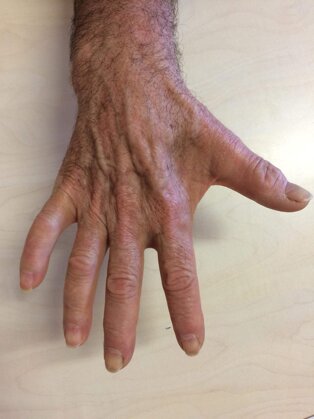
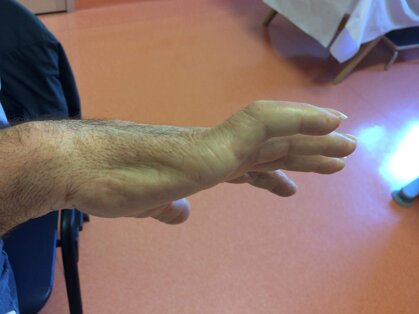
More severe symptoms include: weak or clumsy hand movements, weakness affecting the movements of the fourth and fifth fingers of the hand, muscle atrophy, claw deformity of the hand (SEE PHOTOS BELOW).
Differential diagnosis:
- The pain could be due to an injury of the C8 cervical nerve root.
- Thoracic outlet syndrome: area of entrapment between the rib cage and the clavicle.
- Pancoast tumor (apical lung tumor).
The clinical examination should include Tinel's sign, the elbow flexion test, and checking for Froment's sign.
Conservative treatment: NSAIDs, night splint, elbow brace, therapy, injection.
Surgical treatment: decompress the ulnar nerve with or without transposition (the type of transposition, subcutaneous or submuscular, is still controversial).
The presence of preoperative intrinsic muscle atrophy still leads to a poor prognosis.
A complication of surgery is injury to the medial antebrachial cutaneous nerve. Neurolysis is not useful.
THIS VIDEO IS MADE FOR EDUCATIONAL PURPOSES ONLY.
PLEASE CONSULT YOUR DOCTOR BEFORE MAKING CARE DECISIONS.
Cubital tunnel syndrome:
hand deformity following compression of the ulnar nerve at the elbow
Evident hypotrophy of the dorsal interosseous muscles, particularly severe at the level of the first interosseous, hypotrophy of the hypothenar eminence muscles, also note the "claw-like" posture of the fifth finger

THORACIC OUTLET SYNDROME
FOR SCIENTIFIC AND INFORMATIONAL PURPOSES, CLICK HERE TO LEAVE THIS WEBSITE AND CONNECT TO THE YOUTUBE CHANNEL OF PROFESSOR NABIL A. EBRAHEIM OF THE UNIVERSITY OF TOLEDO, OHIO (USA) AND WATCH AN EDUCATIONAL VIDEO ON THORACIC OUTLET SYNDROME, IN ENGLISH.
In the box below you can read the Italian translation of the English text.
THIS VIDEO IS MADE FOR EDUCATIONAL PURPOSES ONLY. PLEASE CONSULT YOUR PHYSICIAN BEFORE MAKING DECISIONS ABOUT YOUR CARE.
TRANSLATION FROM ENGLISH OF THE TEXT PRESENT IN THE ABOVE EDUCATIONAL VIDEO ON
THORACIC OUTLET SYNDROME
Dr. Ebraheim's educational animated video describes Thoracic Outlet Syndrome (TOS).
TOS is a diagnosis of exclusion based on the patient's history and symptoms. TOS can cause shoulder and neck pain and numbness of the fingers during upper limb movements.
The most common causes: • Nerve and/or vascular structures can be compressed in the thoracic outlet by the cervical rib. • Anomalies of the scalene muscles.
It is a neurovascular compression neuropathy of the brachial plexus in the thoracic outlet in the retroclavicular region with neurogenic or vascular etiology.
The thoracic outlet space is bounded by: • Clavicle, • First rib, • Subclavian muscle; • Costoclavicular ligament, • Anterior scalene muscle.
This space also contains the subclavian vessels and the thoracic duct. It also contains the lower trunk of the brachial plexus (C8, T1).
Two types of TOS: 1. Neurogenic 2. Vascular
Neurogenic TOS is caused by compression of the neurovascular bundle as it passes over the first rib or through the scalene muscle.
Causes of compression: • Cervical rib • Elongated vertebral transverse process (C7 megaprocess) • Anomalies of scalene muscle insertions • Malunion of the first rib • Abnormal fibrous band above or near the two scalene muscles • Repetitive shoulder movement • Extreme arm positions • Abnormal pectoralis minor muscle • Weight lifting • Rowing • Swimming.
Vascular TOS: caused by compressed subclavian vessels or an aneurysm. Where is the site of compression?
• Where the brachial plexus passes over the first rib. Usually at the site of the scalene triangle, the brachial plexus and subclavian artery pass through the triangle (the subclavian vein does not pass through the triangle) • Under the clavicle by the subclavian tendon • Under the conjoint tendon that inserts into the coracoid process.
Diagnosis:
• Symptoms are generally vague • Shoulder and neck pain that usually radiates to the forearm and hand (paresthesia radiating along the arm) • Loss of sensation in the little and ring fingers • There may be some vascular symptoms such as arterial ischemia, venous congestion, Raynaud's phenomenon (color change of the hands or chronic reduction of the arterial pulse) • Look for sensory changes in the cutaneous territory of the ulnar nerve and intrinsic weakness • see if the patient has cold intolerance (Raynaud's phenomenon).
Differential diagnosis:
• C8 radiculopathy or ulnar nerve compression at the elbow. The combination of weakness involving muscles innervated by the median and ulnar nerves may confirm a more proximal lesion of the brachial plexus
• Exclude double crush syndrome such as the association of carpal tunnel syndrome with thoracic outlet syndrome. Compression of the medial antebrachial cutaneous nerve may occur with thoracic outlet compression.
Provocative tests: have a high rate of false positives and have limited clinical value if used alone.
• Adson's Test: most commonly used test, extend and externally rotate the arm while palpating the radial arterial pulse, rotate the head toward the tested arm and may also extend the neck, this leads to a decrease in the interscalene space through tension of the middle and anterior scalene muscles. This test is positive if the radial artery pulse disappears with reproduction of symptoms. The disappearance of the arterial pulse is not specific.
• Wright Test: abduction, external rotation of the arm with the neck rotated to the opposite side which will lead to loss of the arterial pulse and reproduction of symptoms.
• Roos Test (Elevated Arm Stress Test or “EAST”): arm stress analysis. Raise both arms and maintain this position for one minute. Open and close the fingers for three minutes while keeping them above the head. The test is positive if there is reproduction of pain and numbness of the shoulders and fatigue.
Imaging: • The cervical spine may show a cervical rib, • Chest X-ray may show a Pancoast tumor (apical lung tumor) that can put pressure on the brachial plexus causing ulnar nerve symptoms.
Electromyography and nerve studies: results are usually not very helpful.
Vascular studies: can identify a vascular form of thoracic outlet syndrome.
Treatment: •Physical therapy, strengthening the muscles of the shoulder girdle, this is usually the first form of treatment. • Maintain correct posture • Modify physical activity, • Correction of postural imbalances is necessary.
Surgery: decompression is indicated in case of intractable pain, neurological deficit or persistent vascular insufficiency in addition to failure of non-surgical treatment and may include the following procedures: resection of the first rib or cervical rib, if present, release or removal of the anterior and middle scalene muscles, removal of any abnormal structures. Surgery can be performed through a transaxillary or supraclavicular approach.
THIS VIDEO IS MADE FOR EDUCATIONAL PURPOSES ONLY.
PLEASE CONSULT YOUR PHYSICIAN BEFORE MAKING CARE DECISIONS.

LAST MODIFIED JANUARY 31, 2021
© Copyright 2020 Vanni VERONESI. All rights reserved.