The reasons why I consider this scientific article published in 2009 a milestone on this subject are many: the authority of the Authors, the large case series of over 3000 patients, the fact that they also evaluated the mild descent of the cerebellar tonsils (Low-Lying Cerebellar Tonsils) and not only the descent of the cerebellar tonsils sufficient to configure Chiari type I malformation (CM1), and the correlation of the various descents of the cerebellar tonsils with tethered cord syndrome and occult tethered cord syndrome.
I would like to point out that the surgical treatment of tethered cord syndrome and occult tethered cord syndrome was performed under GENERAL ANESTHESIA with section of the INTRADURAL FILUM TERMINALE.
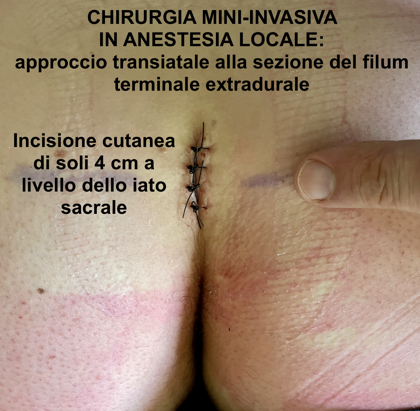
My minimally invasive surgical procedure under LOCAL ANESTHESIA for the EXTRADURAL section of the FILUM TERMINALE, which I will discuss further here and on other pages of the website, was published later in 2018, although I have been performing it since 2010.
© Copyright 2020 Vanni VERONESI. All rights reserved.
Privacy Notice (ITALIANO) / Privacy Policy (ENGLISH)Cookie Notice (ITALIANO) / Cookies information (ENGLISH)
VIDEO TESTIMONIALS
OF PATIENTS OPERATED ON FOR THE SECTION OF THE EXTRADURAL FILUM TERMINALE WITH MINI-INVASIVE SURGICAL TECHNIQUE UNDER LOCAL ANESTHESIA
PATHOLOGIES: Tethered cord syndrome and occult tethered cord syndrome may be associated with Ehlers-Danlos syndrome, craniocervical instability, mild (1 to 4 mm) descent of the cerebellar tonsils (LLCT) or Chiari malformation.
SYMPTOMS: Apart from symptoms related to urinary and faecal sphincter control, those in the lumbar region and lower limbs rarely prevent normal walking.
We filmed the few patients who, preoperatively, had symptoms that prevented normal walking.
We filmed the patients after they underwent our innovative minimally invasive surgery for sectioning the extradural filum under local anaesthesia, documenting the immediate benefits.
THE VIDEOS OF THE PATIENTS' TESTIMONIALS AND MY ORIGINAL TELEVISION INTERVIEWS ARE IN ITALIAN AND ARE PRESENT ON THIS PAGE.
THANKS TO ARTIFICIAL INTELLIGENCE, THEY ARE ALSO AVAILABLE IN ENGLISH AND FRENCH (SEE BOX BELOW).
CUTTING-EDGE SPINAL SURGERY
THE PATIENTS IN THE VIDEOS UNDERWENT MINIMALLY INVASIVE SURGERY OF SECTIONING THE FILUM TERMINALE UNDER LOCAL ANESTHESIA.
THE SURGICAL PROCEDURE LASTS ABOUT 25 MINUTES, AFTER AN HOUR THE PATIENT CAN WALK, EAT AND DRINK.

ENGLISH language:
- Television interviews
- Video testimonials of patients whose limp disappeared after surgery
French language:
TV INTERVIEWS and VIDEO TESTIMONIALS of patients whose limp disappeared after the section of the extradural filum terminale
@veronesisectionfilumterminale
In this playlist, you will find the following:
- TV interviews on occult tethered cord syndrome (OTCS) and tethered cord syndrome (TCS) treated with an innovative minimally invasive surgical procedure consisting of cutting the extradural Filum Terminale under local anaesthesia;
- Video testimonials in which it is possible to evaluate the postoperative clinical outcome of the extradural section of the filum terminale by the minimally invasive procedure under local anaesthesia in patients with preoperative gait disorders.
@veronesisectionfilumterminale
Dans cette playlist vous trouverez:
- Interviews télévisées sur le syndrome de la moelle épinière attachée occulte (oTCS) et syndrome de la moelle épinière attachée (TCS) traité par une chirurgie innovante mini-invasive consistant à couper le Filum Terminale extradural sous anesthésie locale;
- Témoignages vidéo dans lesquels il est possible d'évaluer le résultat clinique postopératoire de la section extradurale du filum terminal par chirurgie mini-invasive sous anesthésie locale chez des patients présentant des troubles de la marche préopératoires.
Case "ZERO" (a milestone for minimally invasive spinal surgery)
65-year-old man
Tethered cord syndrome (S2)
Case “ZERO”: the first minimally invasive surgical treatment of extradural sectioning of the filum terminale, under local anaesthesia, published in a scientific journal, in a patient confined to a wheelchair due to disabling symptoms that prevented him from walking.
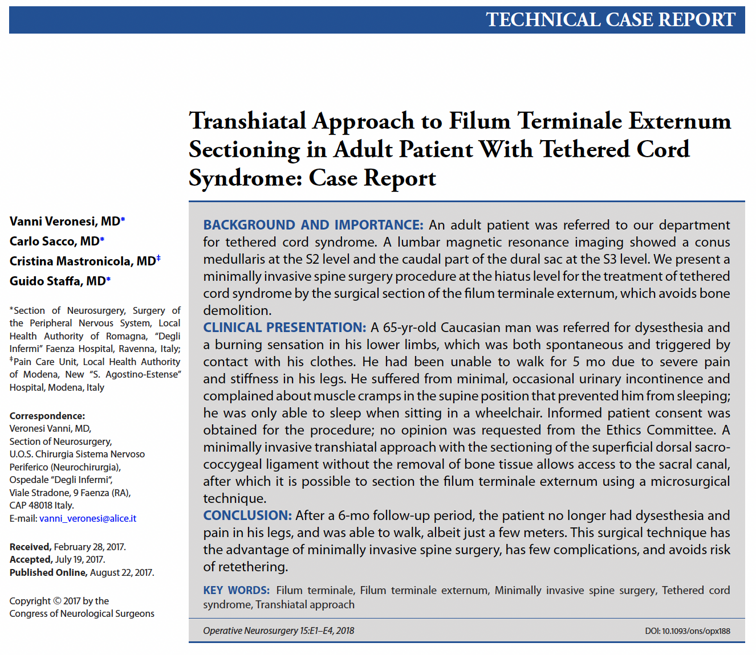
The “ZERO” Case was the subject of a publication as a TECHNICAL CASE REPORT on the innovative minimally invasive surgical technique under local anesthesia, performed by us since 2010, in the prestigious international scientific journal:
OPERATIVE NEUROSURGERY
PATIENT HISTORY
A 65-year-old man complained of dysesthesias with a burning sensation in the lower limbs, both spontaneous and triggered by touch as well as by contact with clothing. He had been unable to walk for 5 months due to severe pain and stiffness in the lower limbs. He suffered from minimal and occasional urinary incontinence. In the supine position, he complained of the onset of muscle cramps in the lower limbs that prevented him from sleeping; he was only able to sleep while sitting in a wheelchair with his legs bent. He had been advised to undergo orthopedic surgery on his knees due to severe tricompartmental gonarthrosis, but because of the neurological symptoms, the orthopedic surgeries had been suspended.
REMOTE CHECK-UP AFTER SURGERY
(see video above)
A significant clinical improvement was observed at the 3- and 6-month follow-ups after surgery. The patient was no longer confined to bed or a wheelchair, was self-sufficient in personal care activities in daily life, and was able to walk, even if only for a few meters.
He no longer had dysesthesias and pain in the lower limbs and no longer experienced muscle cramps in the supine position that prevented him from sleeping. Muscle cramps occurred occasionally in the evening and were of mild intensity. There had been no change in the episodes of minimal and occasional urinary incontinence.
Active and passive mobilization of the lower limbs did not cause any symptoms and the patient had no muscle strength deficits.

CASE 1
38-year-old woman
Occult tethered cord syndrome.

CASE 2
37-year-old woman
Occult tethered cord syndrome.
CASE 3
48-year-old man
Occult tethered cord syndrome.
CASE 4
39-year-old woman
Tethered cord syndrome (L2) in a patient with mild descent (between 1 and 4 mm) of the cerebellar tonsils (LLCT).
CASE 5
33-year-old woman
Occult tethered cord syndrome in a patient with Ehlers-Danlos syndrome, fibromyalgia and small fiber neuropathy.
CASE 6
24-year-old woman
Occult tethered cord syndrome in a patient with mild descent (between 1 and 4 mm) of the cerebellar tonsils (LLCT) and dorsal syringomyelia.
CASE 7
13-year-old girl
Occult tethered cord syndrome in a patient with cervico-dorsal hydromyelia and orthostatic tremor.
CASE 8
38-year-old woman
Tethered cord syndrome (L2) with lipomatous filum terminale.
CASE 9
55-year-old woman
Occult tethered cord syndrome.
CASE 10
44-year-old woman
Tethered cord syndrome (L2) in Chiari type I malformation and cervico-dorsal syringomyelia.
CASE 11
45-year-old woman
Occult tethered cord syndrome in Chiari type I malformation.
CASE 12
31-year-old woman
Occult tethered cord syndrome in patient with mild descent (between 1 and 4 mm) of the cerebellar tonsils (LLCT).
CASE 13
15-year-old girl
Occult tethered cord syndrome.
© Copyright 2020 Vanni VERONESI. All rights reserved.