The reasons why I consider this scientific article published in 2009 a milestone on this subject are many: the authority of the Authors, the large case series of over 3000 patients, the fact that they also evaluated the mild descent of the cerebellar tonsils (Low-Lying Cerebellar Tonsils) and not only the descent of the cerebellar tonsils sufficient to configure Chiari type I malformation (CM1), and the correlation of the various descents of the cerebellar tonsils with tethered cord syndrome and occult tethered cord syndrome.
I would like to point out that the surgical treatment of tethered cord syndrome and occult tethered cord syndrome was performed under GENERAL ANESTHESIA with section of the INTRADURAL FILUM TERMINALE.
My minimally invasive surgical procedure under LOCAL ANESTHESIA for the EXTRADURAL section of the FILUM TERMINALE, which I will discuss further here and on other pages of the website, was published later in 2018, although I have been performing it since 2010.
© Copyright 2020 Vanni VERONESI. All rights reserved.
Privacy Notice (ITALIANO) / Privacy Policy (ENGLISH)Cookie Notice (ITALIANO) / Cookies information (ENGLISH)
LUMBAR MAGNETIC RESONANCE IMAGING (MRI) IN PRONE POSITION IN
OCCULT TETHERED CORD SYNDROME
LUMBAR MRI IN PRONE POSITION IN OCCULT TETHERED CORD SYNDROME and MINIMALLY INVASIVE surgery of EXTRADURAL section of the FILUM TERMINALE under LOCAL ANESTHESIA
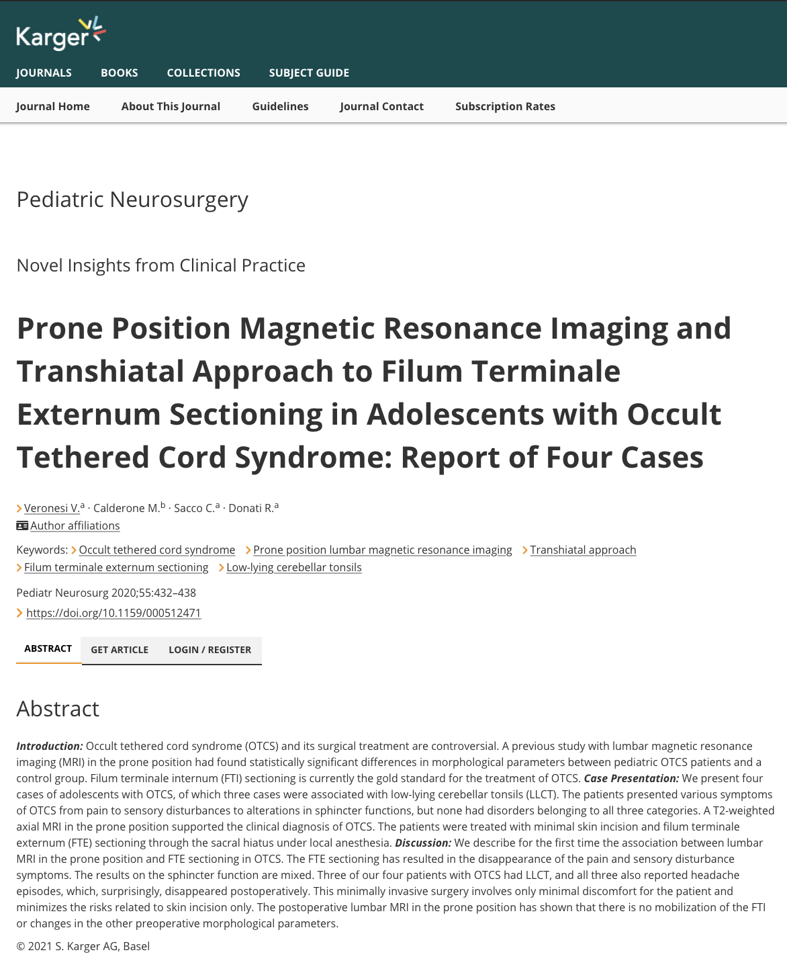
Our scientific work was published in the scientific journal Pediatric Neurosurgery in 2020 and describes the combination of prone lumbar MRI and innovative minimally invasive surgery using extradural section of the filum terminale under local anesthesia in the diagnosis and treatment of occult tethered cord syndrome.
We described this combination of prone lumbar MRI and minimally invasive surgery for the first time in the international medical and scientific literature.
In adult patients, occult tethered cord syndrome can present as a stand-alone condition or in association with slightly descended cerebellar tonsils (LLCT) of 0-4 mm, Chiari malformation, Ehlers-Danlos syndrome, or craniocervical instability.

LUMBAR MRI IN PRONE POSITION IN OCCULT TETHERED CORD and traditional surgery of INTRADURAL SECTION of the filum terminale
terminalunder GENERAL ANESTHESIA
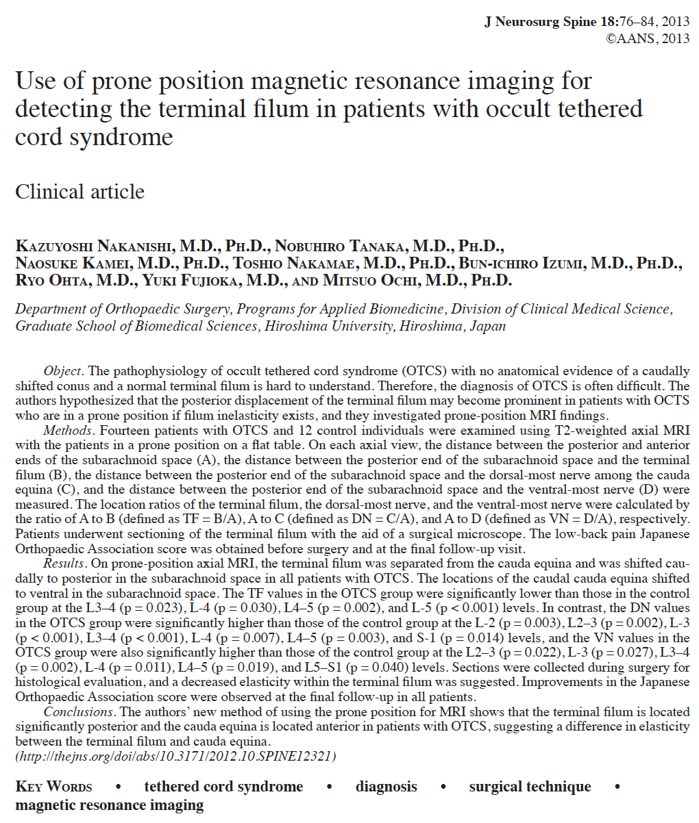
This scientific work from 2013 was published in an international medical journal by the Japanese colleagues from Hiroshima University.
Prone position Magnetic Resonance Imaging was used to identify the abnormal position of the filum at the lumbar intradural level in patients with OCCULT TETHERED CORD syndrome.
The Japanese colleagues compared a group of patients with occult tethered cord syndrome with a group of asymptomatic individuals.
Prone position Magnetic Resonance Imaging showed a significant difference in the position of the filum terminale between the two groups.
In patients with occult tethered cord syndrome, the filum did not move anteriorly with the nerve roots due to gravity but remained in a posterior position (SEE FIGURE AT THE TOP RIGHT, figure on the right).
In lumbar MRI in the prone position, if the filum terminale is not under tension it does not localize posteriorly and does not differ from the position of the nerve roots and cannot be the cause of the symptoms presented by the patient.
Obviously, the finding of the posterior position of the filum terminale cannot assess the intrinsic elasticity of the filum terminale itself but a tense filum terminale can pull the spinal cord to which it is connected, causing the symptoms found in OCCULT TETHERED CORD syndrome.
Since 2014, this examination has been part of the clinical-instrumental protocol adopted for our patients.
Prone position Magnetic Resonance Imaging makes it possible to support the clinical-anamnestic data.
At present, there are no other instrumental examinations that can provide this type of information. In this way, the risk of indicating surgery in patients with symptoms that, being generic and non-specific, may be due to other pathological situations is reduced.
LUMBAR MRI IN PRONE POSITION IN THE TETHERED CORD
AND IN THE RETETHERING
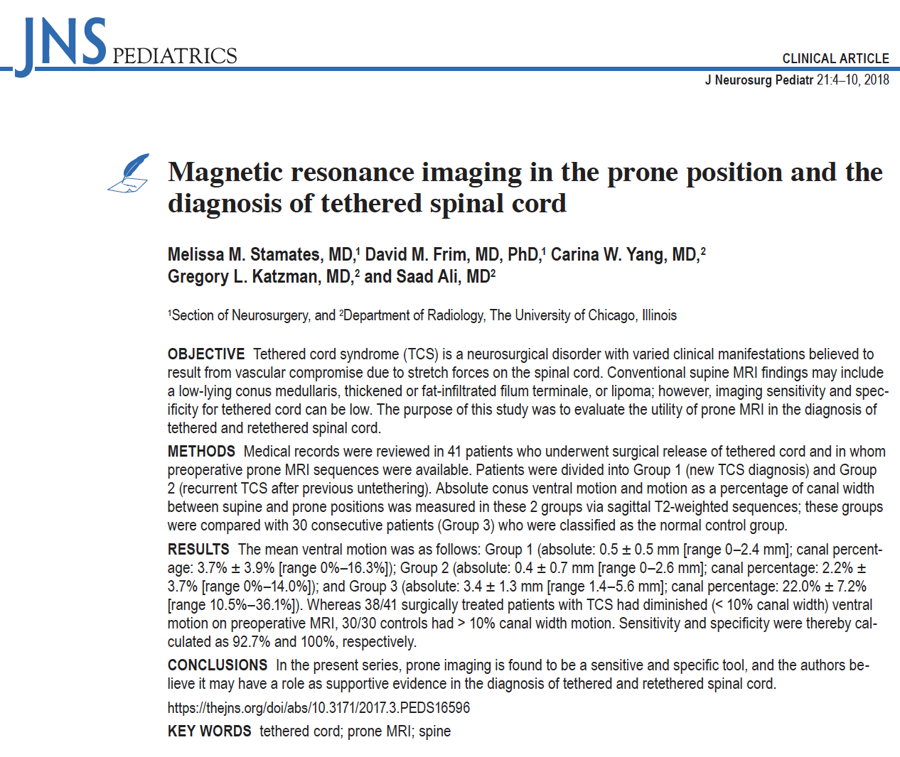
The American colleagues from the University of Chicago conducted a study in 2018 to evaluate the usefulness of lumbar MRI in the prone position in cases of TETHERED CORD and in SPINAL CORD RETETHERING.
They also evaluated a small group of patients with OCCULT TETHERED CORD who, however, are not included in the case analysis.
The American colleagues, in evaluating the percentage of movement of the conus medullaris in the supine and prone positions, conclude their work by stating that:
"In the present series, prone MRI proves to be a sensitive and specific tool and the authors believe it may have a role as a supporting test in the diagnosis of tethered cord or spinal cord retethering."