© Copyright 2020 Vanni VERONESI. All rights reserved.
Informativa sulla Privacy (ITALIANO) / Privacy Policy (ENGLISH)Informativa sui Cookies (ITALIANO) / Cookies information (ENGLISH)
TETHERED CORD SYNDROME AND
OCCULT TETHERED CORD SYNDROME
IN PATIENTS WITH
CHIARI MALFORMARTION TYPE 1 (CM1) OR
LOW-LYING CEREBELLAR TONSILS (LLCT)
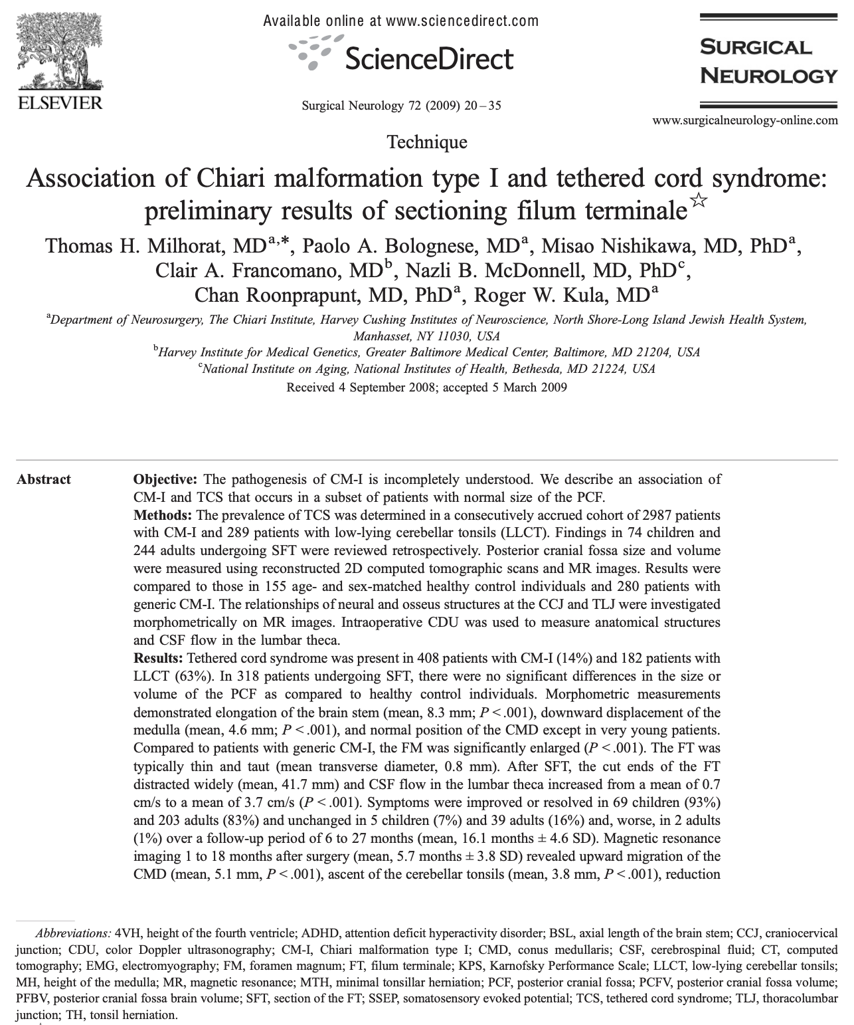
In my opinion this is the best scientific paper on this topic
The reasons why I consider this scientific paper published in 2009 a milestone for this topic are many: the authoritativeness of the Authors, the extensive case history of over 3000 patients, having also evaluated the Low-Lying Cerebellar Tonsils and not only the descent of the cerebellar tonsils such as to configure the Chiari malformation, having correlated the various descents of the cerebellar tonsils to the tethered cord syndrome and the occult tethered cord syndrome.
I point out that the surgical treatment of the tethered cord syndrome and the occult tethered cord syndrome was performed under GENERAL ANAESTHESIA general anaesthesia with the SECTION of the INTRADURAL FILUM TERMINALE.
My minimally invasive surgery under LOCAL ANAESTHESIA with SECTION of the EXTRADURAL FILUM TERMINALE, which I will describe later here but also on other pages of the website, was published in 2018, even though I have been performing it since 2010.
The video goes into the details of the scientific paper
Tethered cord syndrome and occult tethered cord syndrome can be present in patients not only in "pure" form but also in association with other syndromes or pathological conditions. I refer to Ehlers-Danlos syndrome, craniocervical instability, CHIARI MALFORMATION TYPE I (CM1), and LOW-LYING CEREBELLAR TONSILS (LLCT).
For these last two instances, I suggest watching Dr Bolognese’s video, in which he discusses his scientific study on more than 3,000 patients in detail (ASSOCIATION OF CHIARI MALFORMATION TYPE I AND TETHERED CORD SYNDROME: PRELIMINARY RESULTS OF SECTIONING FILUM TERMINALE. Authors: Milhorat TH, Bolognese PA, et al. Scientific Journal: Surg Neurol 72:20-35, 2009).
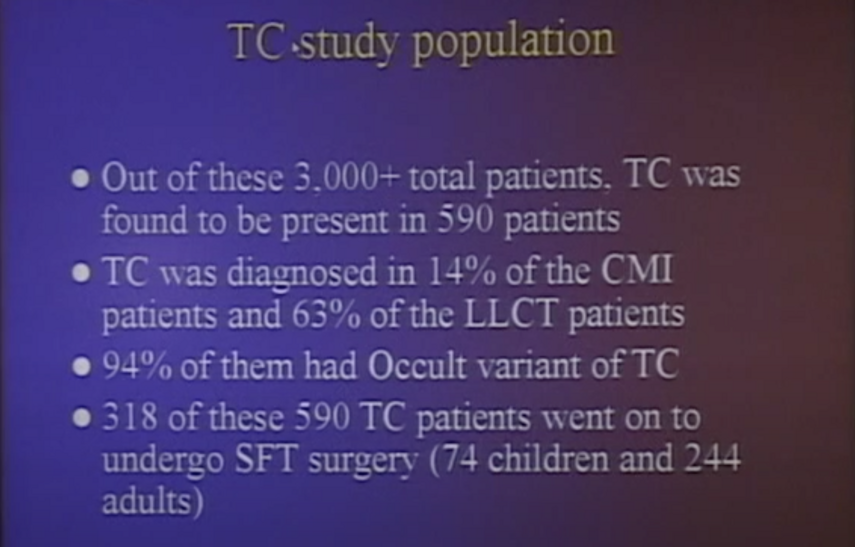
In this scientific study, he reports an association between tethered cord syndrome and occult tethered cord syndrome in 14% of patients with Chiari malformation type I and 63% with Low-Lying Cerebellar Tonsils (LLCT).
In his video, Dr. Bolognese details the aforementioned scientific paper; in particular, I point out that OCCULT TETHERED CORD SYNDROME WERE 93% of the total cases generically defined as tethered cord syndromes, as you can see in the photo below from the video.
Tethered cord syndrome and occult tethered cord syndrome
In my experience, patients operated with a minimally invasive technique under local anaesthesia of a section of the extradural filum terminale can also have benefits for those symptoms not classically attributable to tethered cord syndrome or occult tethered cord syndrome as you can see in the video testimonies and written testimonials that you can find on my website.
However, the objective of the section of the extradural filum terminale is to identify and cure the classic symptoms attributable to occult tethered cord syndrome and tethered cord syndrome.
The clinical diagnosis of tethered cord syndrome or occult tethered cord syndrome is based on the medical history, symptoms and medical examination.
The instrumental supports, which alone do not allow the diagnosis, are lumbar MRI.
In tethered cord syndrome, standard lumbar MRI shows conus medullaris more caudal than the usual level of the lumbar vertebrae L1-L2.
If the conus medullaris ends in the normal position, we suggest a lumbar MRI in the prone position to provide instrumental support for the clinical diagnosis of occult tethered cord syndrome.
Only two scientific papers have evaluated lumbar MRI in the prone position in occult tethered cord syndrome in the medical scientific literature: one by Japanese colleagues from the University of Hiroshima and one by the undersigned:
-USE OF PRONE POSITION MAGNETIC RESONANCE IMAGING FOR DETECTING THE TERMINAL FILUM IN PATIENTS WITH OCCULT TETHERED CORD SYNDROME.
Authors: Nakanishi K. et al. J Neurosurg Spine 18:76–84, 2013;
-PRONE POSITION MAGNETIC RESONANCE IMAGING AND TRANSHIATAL APPROACH TO FILUM TERMINALE EXTERNUM SECTIONING IN ADOLESCENTS WITH OCCULT TETHERED CORD SYNDROME: REPORT OF FOUR CASES.
Authors: Veronesi V. et al. Pediatric Neurosurgery; 2020;55(6):432-438.
However, prone lumbar MRI alone does not allow diagnosis but supports clinical diagnosis of occult tethered cord syndorme.
Clinical diagnosis is made based on the medical history, symptoms and the outcome of the medical examination.
The problem is that prone lumbar MRI is not routinely performed in hospitals.
You can ask if they do this particular MRI in your country.
In Italy, only a few medical centres collaborate with me and perform lumbar MRIs in a prone position.
I published the minimally invasive surgery of the extradural filum terminale section in local anaesthesia for the treatment of tethered cord or occult tethered cord syndrome in the international scientific journal "Operative Neurosurgery";
- TRANSHIATAL APPROACH TO FILUM TERMINALE EXTERNUM SECTIONING IN ADULT PATIENT WITH TETHERED CORD SYNDROME: CASE REPORT.
Authors: Veronesi V. et al. Operative Neurosurgery, 2018 Jul 1;15(1): E1-E4.
This minimally invasive surgery in an anaesthesia locale can be used to treat occult tethered cord syndrome but also tethered cord syndrome.

© Copyright 2020 Vanni VERONESI. All rights reserved.