I motivi per cui considero questo articolo scientifico pubblicato nel 2009 una pietra miliare su questo argomento sono molteplici: l'autorevolezza degli Autori, l'ampia casistica di oltre 3000 pazienti, l'aver valutato anche la lieve discesa delle tonsille cerebellari (Low-Lying Cerebellar Tonsils) e non solo la discesa delle tonsille cerebellari tali da configurare la malformazione di Chiari tipo I (CM1), l'aver correlato le varie discese delle tonsille cerebellari alla sindrome del midollo ancorato e alla sindrome del midollo ancorato occulto.
Faccio presente che il trattamento chirurgico della sindrome del midollo ancorato e della sindrome del midollo ancorato occulto è stato eseguito in ANESTESIA GENERALE con la sezione del FILUM TERMINALE INTRADURALE.
Il mio intervento chirurgico mininvasivo in ANESTESIA LOCALE della sezione EXTRADURALE del FILUM TERMINALE, di cui parlerò più avanti qui e in altre pagine del sito web, è stato pubblicato successivamente nel 2018, anche se lo eseguo dal 2010.
© Copyright 2020 Vanni VERONESI. All rights reserved.
Informativa sulla Privacy (ITALIANO) / Privacy Policy (ENGLISH)Informativa sui Cookies (ITALIANO) / Cookies information (ENGLISH)
PERIPHERAL NERVE INJURIES AND
REPAIR SURGERY VIDEO
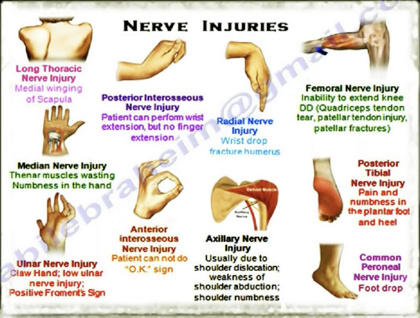
MORE FREQUENT INJURY OF PERIPHERAL NERVES
To the side, a frame of a video by Prof. Ebraheim of the University of Toledo is summarized for scientific and information purposes, summarizing, the most frequent lesions of the peripheral nerves, the consequent deficit of muscle strength, the altered sensitivity and clinical signs. The nerves that most commonly can suffer injury from trauma and the consequent pathological changes are reported in the box below.
READ BEFORE CONTINUING
NOTICE OF SENSITIVITY FOR VISITORS
The scenes reproduced in the surgical videos in the lower part can disturb the sensitivity of the visitors
THOSE WHO DECIDE TO ACCESS THE SURGICAL MOVIES IMPLICITLY AGREE TO THE VISION
The scenes reproduced in the surgical videos in the lower part can disturb the sensitivity of the visitors
THOSE WHO DECIDE TO ACCESS THE SURGICAL MOVIES IMPLICITLY AGREE TO THE VISION

ULNAR NERVE INJURY
SURGICAL TECHNIQUE: END TO END NEURORRHAPHY AND SUBMUSCULAR TRANSPOSITION
Traumatic injury of the ulnar nerve with almost complete nerve section.
Nerve reconstruction performed by means of end-to-end neurorrhaphy and submuscular transposition according to the LEARMONTH surgical technique to avoid the tension at the level of the sutured nerve stumps which allows to obtain the best clinical results.
BY CLICKING ON THE IMAGE NEXT TO THE TEXT YOU EXIT THIS WEB SITE AND ACCESS THE VANNI VERONESI YOUTUBE CHANNEL.

AXILLARY NERVE INJURY
SURGICAL TECHNIQUE: EXTRAPLEXUS NEUROTIZATION - BERTELLI NERVE TRANSFER
Traumatic injury of the axillary nerve.
With this technique, described by BERTELLI, the surgical treatment of the axillary nerve injury is performed with a "NERVE TRANSFER" using as a "donor" a triceps branch of the radial nerve.
The goal is the functional recovery of the deltoid muscle.
BY CLICKING ON THE IMAGE NEXT TO THE TEXT YOU EXIT THIS WEB SITE AND ACCESS THE VANNI VERONESI YOUTUBE CHANNEL.
BRACHIAL PLEXUS INJURY (C5-C6 AVULSION)
SURGICAL TECHNIQUE: EXTRAPLEXUS NEUROTIZATION - OBERLIN NERVE TRANSFER
The NERVE TRANSFER technique described by OBERLIN mainly uses a motor fascicle of the ulnar nerve which is transferred and sutured to the motor branch of the biceps muscle to restore elbow flexion.
Using this technique, the expected result is the recovery of the biceps muscle and they are generally satisfactory but depend on several factors: the nerve suture performed in a healthy area, the use of a single suture without the need for nerves for grafting, the short distance for axonal regeneration to achieve the muscle goal, the use of a well-vascularized nerve for transfer.
This is a procedure that does not cause donor site morbidity.
BY CLICKING ON THE IMAGE NEXT TO THE TEXT YOU EXIT THIS WEB SITE AND ACCESS THE VANNI VERONESI YOUTUBE CHANNEL.
BRACHIAL PLEXUS INJURY
SURGICAL TECHNIQUE: NEUROMA REMOVAL AND SURAL NERVE GRAFT
Traumatic lesion of the brachial plexus at the level of the upper primary trunk with neuroma formation. The brachial plexus is inspected with a double supra and infraclavicular surgical approach to exclude a double level of injury. For the reconstruction of the brachial plexus, after removing the massive neuroma, the sural nerve is removed, prepared and grafted.
BY CLICKING ON THE IMAGE NEXT TO THE TEXT YOU EXIT THIS WEB SITE AND ACCESS THE VANNI VERONESI YOUTUBE CHANNEL.
REMOVAL OF THE SURAL NERVE FOR NERVOUS GRAFTES
When nerve injuries need a graft, another nerve is used to bridge the loss of nerve substance. The nerve commonly used as a "donor" is the sural nerve which is located in the lateral part of the leg and is a purely sensory nerve so removal will not lead to a lack of muscle strength in the leg or foot.
As seen in the photo and will be seen in the movie, the construction of the graft there may be asymmetries linked to the anatomical part to be reconstructed (see graft on the left).
BY CLICKING ON THE IMAGE NEXT TO THE TEXT YOU EXIT THIS WEB SITE AND ACCESS THE VANNI VERONESI YOUTUBE CHANNEL.
LAST UPDATE 11th APRIL
© Copyright 2020 Vanni VERONESI. All rights reserved.