I motivi per cui considero questo articolo scientifico pubblicato nel 2009 una pietra miliare su questo argomento sono molteplici: l'autorevolezza degli Autori, l'ampia casistica di oltre 3000 pazienti, l'aver valutato anche la lieve discesa delle tonsille cerebellari (Low-Lying Cerebellar Tonsils) e non solo la discesa delle tonsille cerebellari tali da configurare la malformazione di Chiari tipo I (CM1), l'aver correlato le varie discese delle tonsille cerebellari alla sindrome del midollo ancorato e alla sindrome del midollo ancorato occulto.
Faccio presente che il trattamento chirurgico della sindrome del midollo ancorato e della sindrome del midollo ancorato occulto è stato eseguito in ANESTESIA GENERALE con la sezione del FILUM TERMINALE INTRADURALE.
Il mio intervento chirurgico mininvasivo in ANESTESIA LOCALE della sezione EXTRADURALE del FILUM TERMINALE, di cui parlerò più avanti qui e in altre pagine del sito web, è stato pubblicato successivamente nel 2018, anche se lo eseguo dal 2010.
© Copyright 2020 Vanni VERONESI. All rights reserved.
Informativa sulla Privacy (ITALIANO) / Privacy Policy (ENGLISH)Informativa sui Cookies (ITALIANO) / Cookies information (ENGLISH)
LUMBAR MAGNETIC RESONANCE (MR)
IN PRONE POSITION:
- TETHERED CORD
- OCCULT TETHERED CORD
LUMBAR MRI IN PRONE POSITION and minimally invasive surgery of SECTION FILUM TERMINALE EXTERNUM (EXTRADURAL)
under local anaesthesia in the OCCULT TETHERED CORD
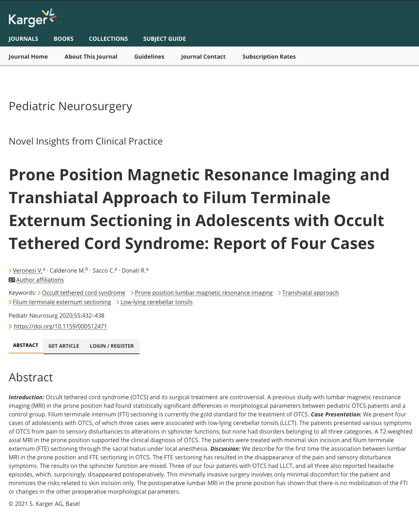
In 2020 were published in the scientific journal Pediatric Neurosurgery our innovative protocol. It involves the association between lumbar MRI in the prone position and minimally invasive surgery of the filum terminale extradural (externum) section under local anaesthesia.
We described this protocol for the first time in the international medical scientific literature.
The patients operated with this protocol are generally adult patients, and to date, they are over 200, the 4 adolescent patients operated on have been the subject of the aforementioned scientific work.
In adult patients, the occult tethered cord can present itself as the only pathology or association with the presence of the tonsils slightly descended cerebellar, 0-4 mm (LLCT), or Chiari malformation.

LUMBAR MR IN PRONE POSITION
IN OCCULT TETHERED CORD
This 2013 scientific work was published in an international medical journal by Japanese colleagues from the University of Hiroshima.
Magnetic resonance imaging in a prone position was used to identify the abnormal position of the filum at the lumbar intradural level in patients with occult tethered cord syndrome. Japanese colleagues compared a group of patients with occult tethered cord syndrome with a group of people asymptomatic.
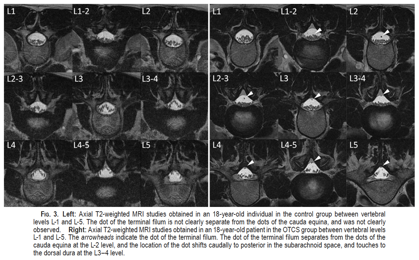
Magnetic resonance imaging in the prone position showed a significant difference in the position of the filum terminale between the two groups. In patients with occult tethered cord syndrome the filum terminale was not carried by gravity anteriorly with the nerve rootlets but remained in the posterior position (SEE FIGURE IN HIGH RIGHT, figure on the right).
In the lumbar MRI in the prone position, if the filum terminale is not under tension, it does not locate posteriorly and does not differ from the position of the nerve roots and cannot be the cause of disorders presented by the patient. The finding of the posterior position of the filum terminale cannot evaluate the intrinsic elasticity of the filum terminale itself but a stretched filum terminale can traction the spinal cord to which it is connected causing the disturbances that are found in the occult tethered cord syndrome. It is part of the clinical-instrumental protocol adopted for our patients. Magnetic resonance in the prone position allows to support the clinical-anamnestic data. At present there are no other instrumental tests that can give this type of information. This reduces the risk of placing surgical indications in patients with symptoms which, being generic and non-specific, may be due to other pathological situations.
IMAGE ON TOP LEFT. Abstract of the scientific work published in the Neurosurgical Journal Spine 2013.
IMAGE ON TOP RIGHT. Axial images of the lumbar magnetic resonance imaging in a prone position to evaluate the position of the filum terminale intradural:
- on the left: images of a healthy person in the control group;
- on the right: images of a patient with occult tethered cord syndrome. In patients with occul tethered cord syndrome the filum terminale does not move anteriorly with the nerve roots but remains in the posterior position (WHITE ARROW HEAD).


LUMBAR MR IN PRONE POSITION
IN TETHERED CORD
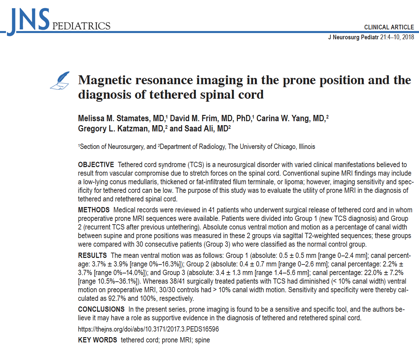
In 2018, American Colleagues from the University of Chicago carried out a study to evaluate the usefulness of lumbar MRI in a prone position in the cases of TETHERED CORD and in RIANCORAGGIO MIDOLLARE.
They also evaluated a small group of patients with OCCULT TETHERED CORD who are not part of the case analysis.
American colleagues in evaluating the percentage of movement of the spinal cone in the supine and prone position conclude their work by stating that: "In the present series, MRI in the prone position proves to be a sensitive and specific tool and the authors believe it may have a role as evidence of support in the diagnosis of anchored marrow or spinal cord rearrangement. "
IMAGE ON TOP LEFT:
- Abstract of the scientific work published in the Journal Neurosurg Pediatrics 2018.
IMAGE ON TOP RIGHT. Images relating to the evaluation of the percentage of mobility of the medullary cone (ventral conus motion):
- On the left an example of how the aforementioned mobility of the medullary cone is calculated.
- On the right a negative test in which there is a wide mobility of the medullary cone not compatible with the presence of tethered cord.

LAST UPDATE 28th FEBRUARY 2021
© Copyright 2020 Vanni VERONESI. All rights reserved.